
World history is shaped by major events that changed civilizations, influenced cultures, transformed governments, and altered the course of human progress. From ancient discoveries to modern technological revolutions, certain moments in history have had a lasting impact on humanity. These events not only changed the societies in which they occurred but also influenced future generations across the globe.
Understanding the most important events in world history helps us learn how human civilization evolved and how the modern world came to be. Here are some of the most significant historical events that changed the course of humanity forever.
1. The Agricultural Revolution
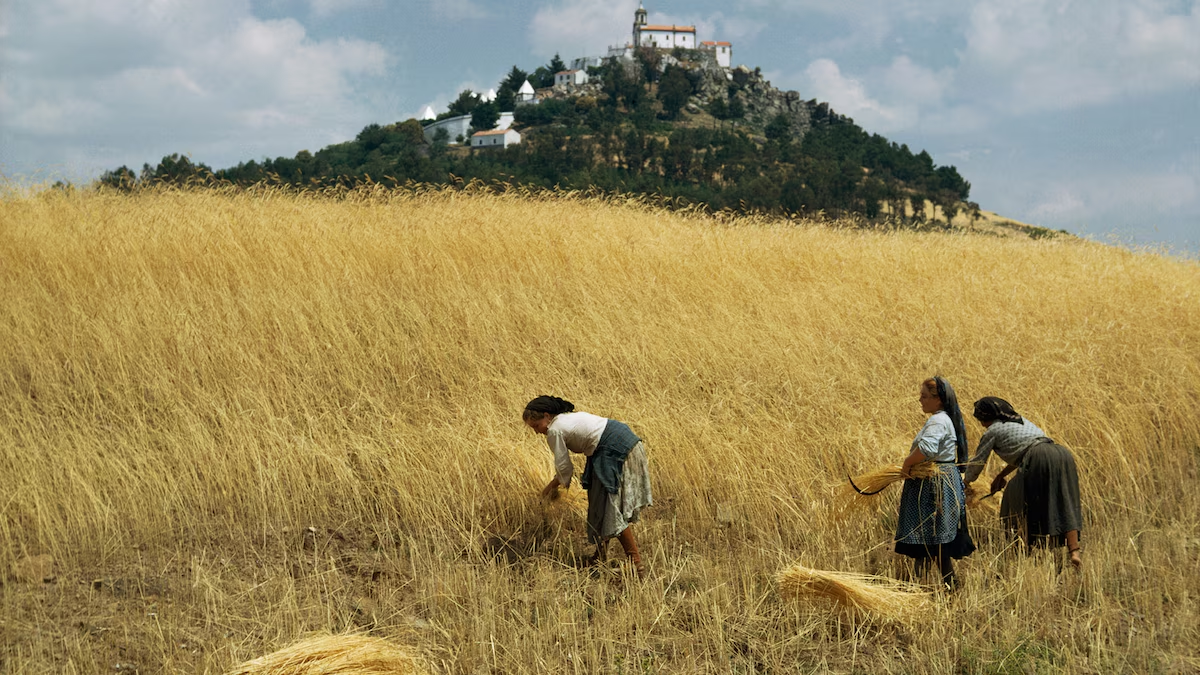
One of the earliest and most important events in human history was the Agricultural Revolution, which began around 10,000 BCE. Before agriculture, humans lived as hunters and gatherers, constantly moving in search of food.
The development of farming allowed people to grow crops and domesticate animals, leading to permanent settlements and the rise of civilizations. Agriculture created food surpluses, which supported population growth and economic development.
This revolution laid the foundation for cities, governments, trade, and social structures. Without agriculture, modern civilization would not exist.
2. The Rise of Ancient Civilizations
The emergence of ancient civilizations such as Mesopotamia, Egypt, India, China, Greece, and Rome marked a major turning point in world history. These societies introduced important developments in writing, mathematics, architecture, law, and governance.
Ancient Egypt became famous for its pyramids and engineering achievements, while Mesopotamia introduced one of the earliest writing systems. Ancient Greece contributed to philosophy, democracy, and science, and the Roman Empire influenced legal systems and infrastructure across Europe.
These civilizations shaped human culture and created systems that continue to influence modern society.
3. The Birth of Major Religions
The rise of major world religions, including Christianity, Islam, Buddhism, and Hinduism, had a profound impact on human history. Religious beliefs influenced cultures, politics, moral values, and social systems across continents.
The spread of Christianity transformed Europe and later expanded globally through exploration and colonization. Islam rapidly spread across the Middle East, Africa, and Asia, contributing greatly to science, trade, and education during the Islamic Golden Age.
Religions have played central roles in shaping civilizations, inspiring art and literature, and influencing historical conflicts and cooperation.
4. The Fall of the Roman Empire
The fall of the Roman Empire in 476 CE was one of the most significant events in European history. Rome had dominated much of Europe, North Africa, and the Middle East for centuries.
Its collapse led to political instability, economic decline, and the beginning of the Middle Ages in Europe. The fall of Rome also reshaped trade systems and enabled new kingdoms and cultures to emerge.
Although the empire collapsed, Roman achievements in law, engineering, architecture, and governance continued to influence future societies.
5. The Renaissance
The Renaissance, which began in Italy during the 14th century, marked a period of cultural, artistic, and intellectual revival in Europe. It represented a renewed interest in classical learning, science, and human creativity.
Artists such as Leonardo da Vinci and Michelangelo created masterpieces that continue to inspire the world today.
The Renaissance encouraged scientific thinking, exploration, and innovation. It also helped lay the groundwork for modern education, art, and scientific advancement.
6. The Age of Exploration
During the 15th and 16th centuries, European explorers traveled across oceans in search of trade routes and new territories. Explorers such as Christopher Columbus and Vasco da Gama opened connections between continents.
The Age of Exploration expanded global trade and cultural exchange, but also led to colonization, exploitation, and conflicts. European powers established empires across the Americas, Africa, and Asia.
This period changed global economics, politics, and demographics permanently.
7. The Industrial Revolution
The Industrial Revolution, which began in the late 18th century, transformed the world through machines, factories, and technological innovation. Production shifted from handmade goods to industrial manufacturing.
Steam engines, railways, and mechanized factories dramatically increased productivity and changed transportation and communication systems. Cities grew rapidly as people moved from rural areas to work in factories.
The Industrial Revolution improved economic growth and technological advancement, but also created social challenges, including poor working conditions and environmental pollution.
Modern industrial society is largely the result of this historic transformation.
8. The American and French Revolutions
The American Revolution and the French Revolution introduced powerful ideas about democracy, equality, and human rights.
The American Revolution led to the creation of the United States and inspired democratic movements worldwide. The French Revolution challenged the monarchy and promoted ideas of liberty and citizenship.
These revolutions changed political systems and encouraged people around the world to demand freedom and representation.
9. World War I
World War I was one of the deadliest conflicts in history. It involved many of the world’s major powers and resulted in massive destruction and loss of life.
The war changed political borders, weakened empires, and introduced new military technologies. It also created economic and political instability that contributed to future global conflicts.
World War I reshaped international relations and altered the balance of power in Europe and beyond.
10. World War II
World War II is considered one of the most significant events in modern history. The war caused enormous destruction, millions of deaths, and the Holocaust.
The conflict led to the defeat of Nazi Germany and Imperial Japan while establishing the United States and the Soviet Union as global superpowers. It also resulted in the formation of the United Nations to promote international peace and cooperation.
World War II changed global politics, economies, and societies forever.
11. The Cold War
The Cold War was a period of political and military tension between the United States and the Soviet Union after World War II. Although there was no direct large-scale war between the two superpowers, the world experienced nuclear competition, espionage, and ideological conflict.
The Cold War influenced global alliances, space exploration, and technological development. Events such as the Space Race and the Cuban Missile Crisis highlighted the intense rivalry between capitalism and communism.
The collapse of the Soviet Union in 1991 officially ended the Cold War and changed global political structures.
12. The Digital Revolution
The rise of computers, the internet, and digital technology in the late 20th and early 21st centuries transformed communication, business, education, and entertainment.
The Digital Revolution connected the world through instant communication and information sharing. Innovations such as smartphones, artificial intelligence, and social media continue to reshape modern life.
Technology has created new industries, changed global economies, and influenced nearly every aspect of daily living.
13. The COVID-19 Pandemic
The COVID-19 pandemic became one of the most impactful events of the modern era. The pandemic affected healthcare systems, economies, travel, education, and social behavior worldwide.
Governments introduced lockdowns, vaccination campaigns, and public health measures to control the spread of the virus. The pandemic also accelerated remote work, online learning, and digital transformation globally.
COVID-19 demonstrated how interconnected the modern world has become and highlighted the importance of global cooperation during crises.
Conclusion
History is shaped by events that influence humanity for generations. From the Agricultural Revolution to the Digital Revolution, each major event contributed to the development of civilizations, economies, cultures, and political systems.
These historical moments teach us valuable lessons about innovation, conflict, cooperation, and human resilience. Understanding the most important events in world history helps us appreciate how the modern world was formed and prepares us to face future challenges with greater knowledge and awareness.
As history continues to unfold, future generations will likely add new events to this list that will shape the world in ways we cannot yet imagine.